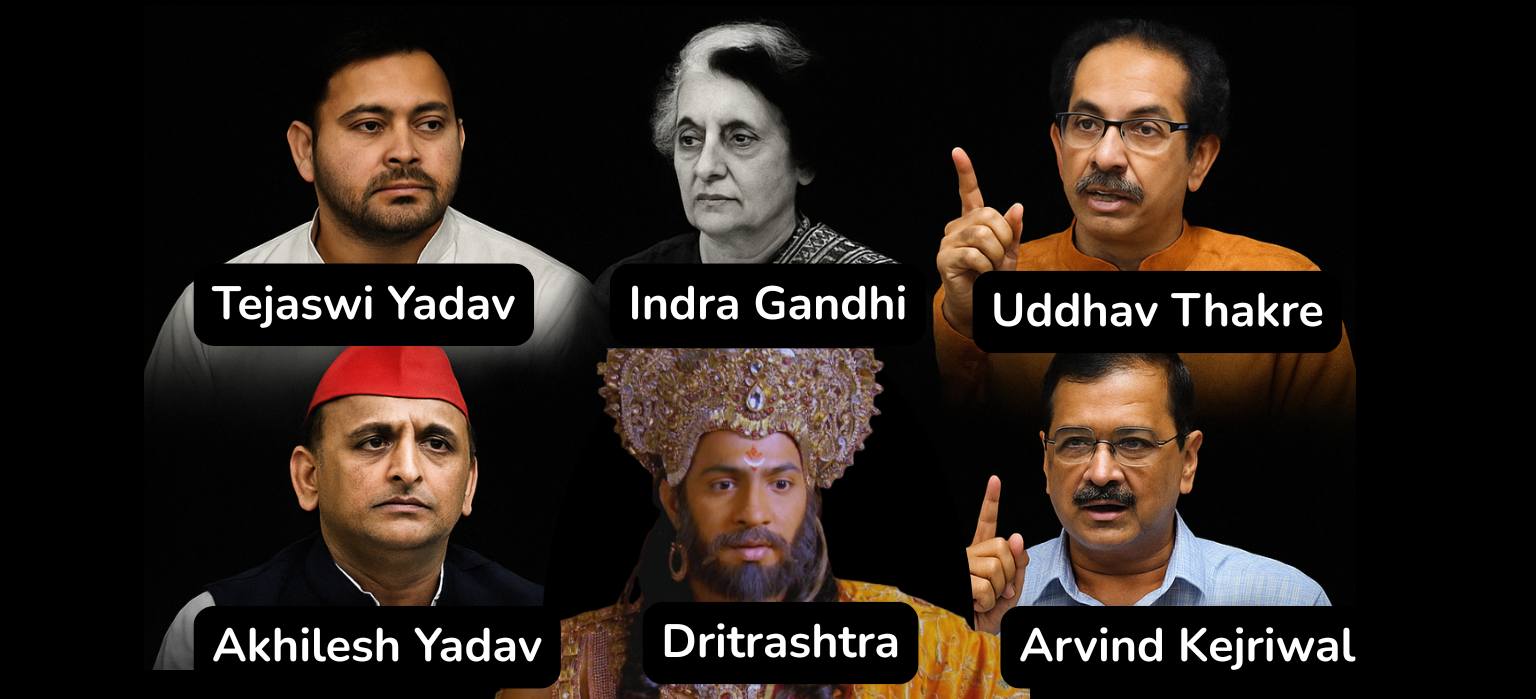
The Sanjay Paradox: Why Leaders with ‘Sanjay Advisors’ Repeatedly Collapse
Introduction
Indian politics is full of visible and invisible patterns. But during a behavioural leadership analysis, Politix Matrix discovered a recurring phenomenon: whenever a dominant advisor named Sanjay rises inside a leader’s inner circle, the system around them begins to crack.
This pattern stretches from ancient epics to modern elections. It is not astrology, not coincidence — it is behavioural politics.
We call it: The Sanjay Paradox.
1. The Origin: Sanjaya of the Mahabharata
The earliest “Sanjay” appears in the Mahabharata as Dhritarashtra’s advisor blessed with divine vision. He saw the war, warned the king, narrated the truth — and yet was ignored. The result was the collapse of the Kuru Empire.
Symbolically, the pattern begins here: a Sanjay warns, a leader miscalculates, and downfall follows.
2. Modern Political Case Studies
Across five decades, Politix Matrix identified six major political collapses linked with high-influence “Sanjay” advisors. The pattern is remarkably consistent.
Case 1: Indira Gandhi & Sanjay Gandhi
His aggressive inner-circle control during the Emergency sparked public anger, leading to Congress’ historic defeat in 1977.
Case 2: Uddhav Thackeray & Sanjay Raut
Raut’s confrontational communication and dominance contributed to the factional rebellion that split Shiv Sena and unseated Uddhav as Chief Minister.
Case 3: Tejashwi Yadav & Sanjay Yadav
A powerful strategist whose influence triggered internal family tensions, MLA frustration, and strategic miscalculations — resulting in electoral setbacks.
Case 4: Arvind Kejriwal & Sanjay Singh
As AAP’s most aggressive national face, Sanjay Singh’s confrontations and legal battles shifted AAP’s narrative from governance to damage control, weakening electoral momentum.
Case 5: Akhilesh Yadav & Sanjay Lathar
His rise symbolized Akhilesh’s youth-led faction, provoking old-guard resistance and widening SP’s internal cracks, especially during leadership transitions.
Case 6: Lalu Prasad Yadav & Sanjay Jha
Known for aggressive TV commentary, he often created narrative fires instead of solutions, contributing to long-term reputational damage for RJD.
3. The Behavioural Template Behind the Sanjay Paradox
Across all six cases, Politix Matrix identified a repeating behavioural archetype:
- Dominant presence that overshadows senior leaders.
- Aggressive decision-making leading to reactive strategies.
- Media-heavy visibility that shifts narrative focus away from leadership.
- Centralized control that bypasses institutional structures.
- Ground disconnect and misreading of public sentiment.
- Leader dependency where one advisor becomes the single point of influence.
When an advisor becomes more powerful than the leader, collapse becomes inevitable.
4. Why the Name “Sanjay” Became Common
The paradox is not about the name. It is about the behaviour. But the name “Sanjay” became common due to:
- Sanskrit revival in the 1960s–80s
- Political influence of Sanjay Gandhi
- Bollywood popularity (Sanjay Dutt, Sanjay Khan, etc.)
- Modern, short, masculine phonetic appeal
The name is coincidental. The behavioural pattern is real.
Conclusion
The Sanjay Paradox is not superstition — it is a political warning. Leaders fall when advisors overshadow them. The “Sanjay” cases merely expose a deeper truth: power without balance creates collapse.
Politix Matrix will continue decoding the hidden behavioural forces shaping Indian politics.
Politix Matrix • Decoding Power, Behaviour & Elections.